Check Point: Asean Taxonomy Version 3
Fine-tune underway.
 by
by 
 By Julia Chong
On 27 March 2024, the Association of Southeast Asian Nations’ (ASEAN) Taxonomy Board (ATB) announced the most recent iteration, Version 3, of the ASEAN Taxonomy for Sustainable Finance (ASEAN Taxonomy). In line with its predecessors, Version 3 of the ASEAN Taxonomy is currently undergoing a stakeholder consultation process in order to help fine-tune the framework.
The ATB is a collaborative initiative comprising four sectoral bodies which jointly oversee the development of the umbrella framework:
The ATB’s mandate in this regard is to introduce a common language under which sustainable economic financing can flourish and support the goals of the 26th United Nations Climate Change Conference of the Parties or COP26. At the meeting, each ASEAN member state outlined its revised nationally determined contributions (NDCs). The NDC is a national-level plan which a country submits detailing how they will reduce emissions and limit global warming. The current NDCs of ASEAN member states are summarised in Figure 1.
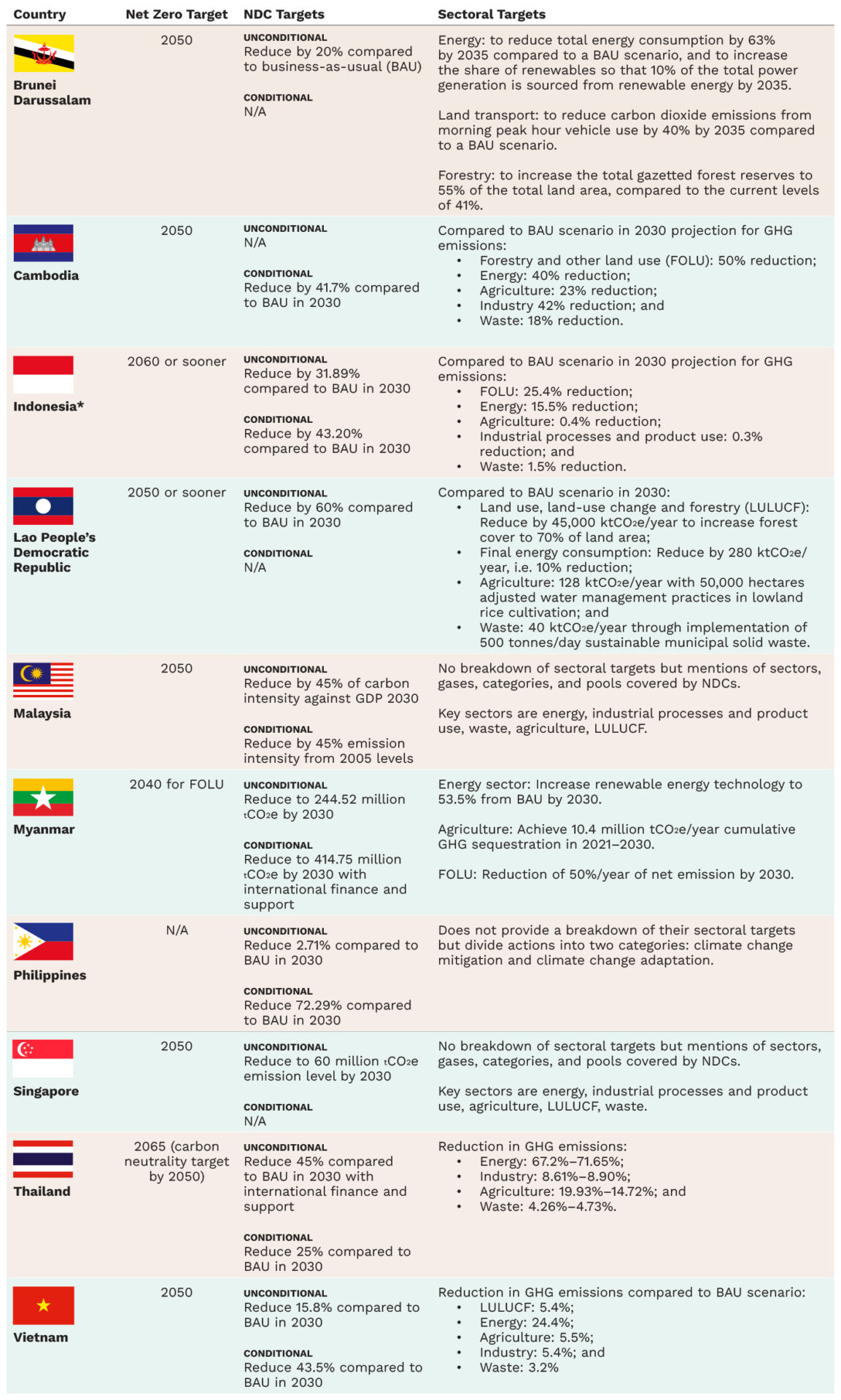
An Evaluation of ASEAN Renewable Energy Path to Carbon Neutrality, a 2023 research paper principally written by Khairul Eahsun Fahmi, PhD researcher at the University of Brunei Darussalam, gauged the status of the NDCs by ASEAN member states at the time of its writing:
“The COP26 in Glasgow in late 2021 demanded considerable efforts from governments all over the world. The meeting’s key deliverables were the revised Nationally Determined Contributions (NDCs), signatories to the Glasgow Climate Pact, and the Global Coal to Clean Power Statement, which could be essential to fulfilling climate targets. The countries’ long-term strategies are intended to outline tangible activities that will strengthen the desire to go beyond the NDC targets.
“Five ASEAN member states submitted updated NDCs before the COP26 meeting in 2020, while the remainder did so in 2021. In the most recent report, nine ASEAN member states established unconditional targets for lowering emissions. Only Cambodia has a conditional goal. All ASEAN member states selected the energy and agricultural industries as the main sources of the emissions reduction target when it came to sector coverage.
“Additionally, all ASEAN member states, with the exception of Myanmar, listed trash and industrial processes and product usage as additional culprits. Only the Philippines and Thailand did not classify land use, land-use change, and forestry emissions’ reduction factors. In addition to conditionality and sectoral coverage, the NDCs establish a detailed range of greenhouse gas (GHG) emissions. The majority of GHGs, such as carbon dioxide (CO2), methane (CH4), nitrous oxide (N2O), hydrofluorocarbons, perfluorocarbons, sulphur hexafluoride, and nitrogen trifluoride, have been included in both Malaysia and Singapore’s NDCs. However, Myanmar’s NDC only mentions CO2. Aside from CO2, which was included in all of the ASEAN member states’ NDCs, nine recorded CH4, and N2O.”
Version 1 of the ASEAN Taxonomy was released by the ATB in November 2021. The inaugural document provided a framework to kick start the discussions between private sector stakeholders and national authorities for its development. Together with the consultation which ensued, it introduced the tenets that would guide the Southeast Asian union’s trajectory towards COP26’s net-zero aspirations and serves as the reference point to “guide capital and funding towards activities that can help promote the systemic transformation needed for the region.”
The unique feature of the ASEAN Taxonomy is its focus on harmonisation, as opposed to standardisation, of sustainable frameworks throughout the diverse region. Many are still heavily dependent on fossil fuels with each of the 10 member states (with an 11th member state, Timor-Leste, currently under discussion for inclusion) at various stages of economic development, making the transition to a low-carbon future more challenging.
From the outset of its initial 87-page document, the ASEAN Taxonomy maps the different possible transition paths for service-based economies such as Malaysia and Singapore versus the oil-and-gas-dependent nations of Brunei Darussalam and Indonesia. This is reflected in the taxonomy’s principles-based approach which is built upon two tiers: a Foundation Framework (FF) whereby an economic activity must fulfil certain criteria and is classified based on a colour-coded system of green, amber, or red; and a Plus Standard (PS) which further screens an activity through application of the technical screening criteria (TSC) to more accurately determine its place in the taxonomy. The PS is also intended to facilitate inclusivity among member states, allowing for different levels of adoption depending on each country’s individual readiness.
This approach stands in stark contrast to the pathway adopted by other unified groupings, such as the European Union, which are essentially binary, i.e. a business activity is classified as either ‘green’ or ‘brown’ – an approach that does not fully account for transition activities where low-carbon alternatives are not yet fully realisable.
In March 2023, the ATB released Version 2 which included the TSC for the electricity, gas, steam, and air conditioning supply (energy) sector, providing specific guidance on how it should be applied. Version 2 became effective on 19 February 2024 after incorporating feedback from stakeholder consultations.
In its latest iteration on 27 March 2024, the ASEAN Taxonomy Version 3 made public the TSC for two more focus sectors: transportation and storage (e.g. urban and freight transport, and infrastructure for land, water, and air transport) and construction and real estate (e.g. construction and renovation of buildings, demolition and site preparation, and acquisition and ownership of buildings).
Other refinements are:
The incorporation of stakeholder feedback and lessons learnt from on-the-ground rollouts in member states from previous consultation rounds means that the focus has also increased in other key areas, including interoperability with the EU Taxonomy and other national taxonomies. Interoperability means that there is, at the macro level, a symbiotic relationship between the development of these different yet similar taxonomies. For instance, Version 3 notes that national taxonomies in ASEAN “vary in scope and approaches based on the different priorities, tolerances, and pathways in their own respective jurisdictions, but all also need to reflect the expectations of international investors” and illustrates this through the experience of Malaysia and other Southeast Asian nations.
“Bank Negara Malaysia’s Climate Change and Principle-based Taxonomy utilises a principles-based approach and considers the state of economic development of the country and their nascent stage of climate risk management at which businesses and other economic agents operate. Although this Taxonomy mainly aims to address climate change, there are some biodiversity considerations that are also integrated within the Guiding Principles. Malaysia’s capital market regulator, the Securities Commission Malaysia, also developed the Sustainable and Responsible Investment Taxonomy, to enable capital market participants to identify economic activities that are aligned with the environment, social, and sustainability objectives. The intention of this is to facilitate a more informed and efficient decision-making process for fundraising and investing.”
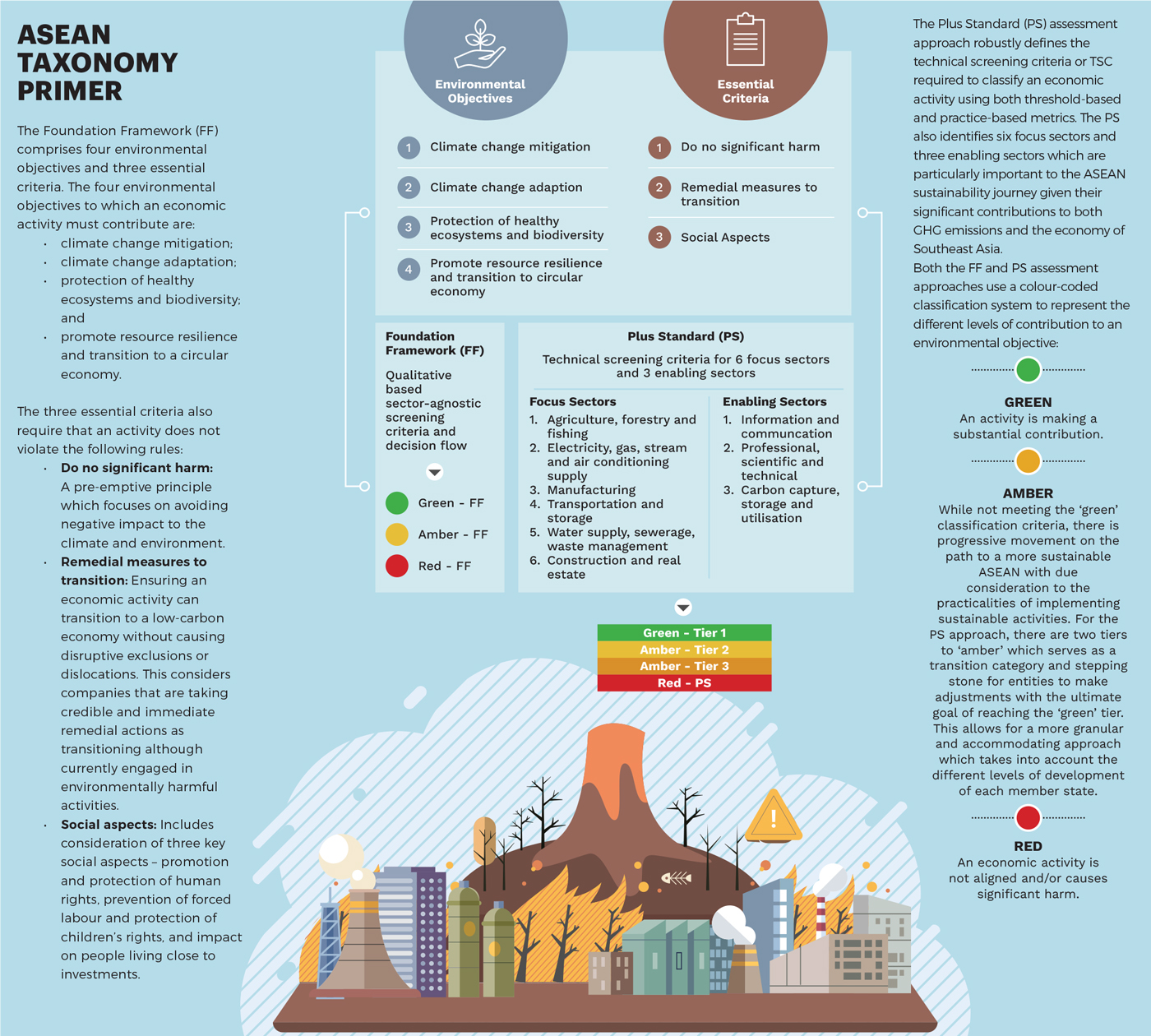
The ASEAN Taxonomy has drawn on learnings from the EU Taxonomy and intends to be interoperable with it as well as other international and national taxonomies. What needs to be emphasised is the symbiotic and consultative nature embedded in the development of these taxonomies, which at the end of the day must all be geared towards achieving climate targets and increased global sustainability.
As momentum builds within ASEAN to reinforce the global net-zero climate goals by 2050, a multitude of other initiatives have sprouted to support this at various levels throughout the Asia-Pacific region. It is indication that the region itself is poised to be a vibrant and supportive ally in the quest for climate justice in finance. Such diverse views should feature considerably in how ASEAN intends to refine its approach in one that is as unique as its individual member states.
Julia Chong is a content analyst and writer at Akasaa, a boutique content development and consulting firm.