Architecting Sustainability in Banking Strategy
A Chief Sustainability Officer leads on why it’s imperative that banks show up not just as lenders, but as trusted advisors.
 by
by 
A Chief Sustainability Officer leads on why it’s imperative that banks show up not just as lenders, but as trusted advisors.
by 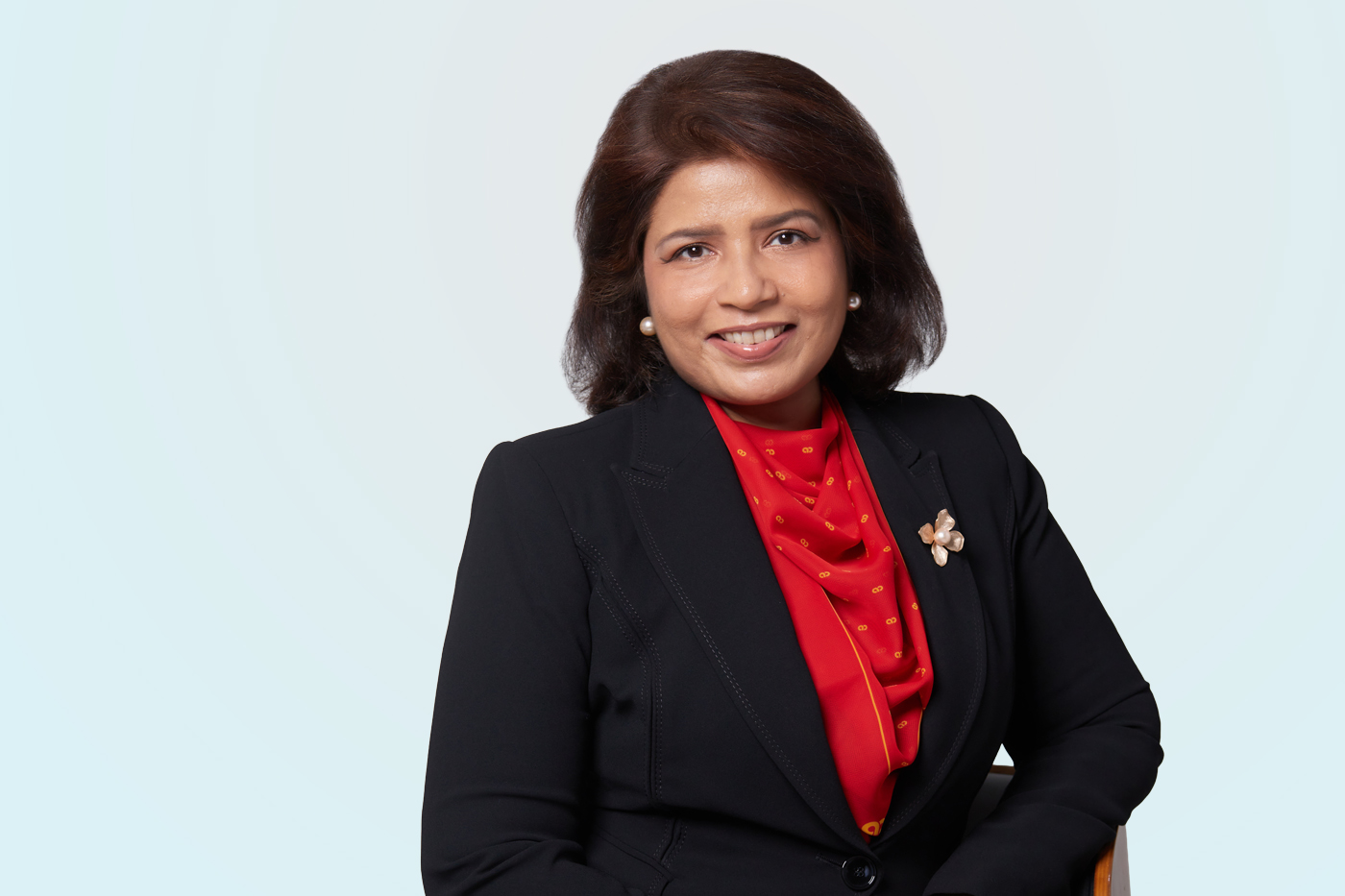
By the Banking Insight Reporting Team
Throughout the multifaceted career of Amanah Aboobucker, FCB, her current role as advocate for ethical finance is perhaps the most challenging and rewarding. With over 30 years under her belt, the Chief Sustainability Officer of AmBank Group brings a wealth of technical expertise in product management, compliance, risk management, audit, and leadership to her current mission. Her riveting panel sessions with the Institute on green finance and innovations have opened up new possibilities for our members and delegates. She shares more of the same in this exclusive interview.
Q: Sustainability in banking sometimes runs the risk of being treated as a parallel approach. As Chief Sustainability Officer of the AmBank Group, how do you embed sustainability at the core of banking strategy?
Firstly, thank you for inviting me to share my thoughts. At AmBank Group, the answer begins with our Winning Together 2029 strategy. When we unveiled that strategy in 2024, sustainability was not positioned as a supporting initiative or a values statement – it was established as one of three core pillars, alongside digitalisation and operational excellence. That architectural decision matters enormously. It means sustainability has a seat at the same table as the Group’s commercial and operational priorities, with the same board-level visibility, the same rigour of measurement, and the same accountability structure. It is a signal – internally and externally – that sustainability is not a parallel track, but one that facilitates long-term value creation to the Group, responsibly.
I say this with the benefit of a particular vantage point. Before this role, I spent some years helping to steer AmBank’s compliance and conduct transformation – building the frameworks, accountability structures, and cultural habits that made responsible behaviour the default rather than the exception. That experience taught me something fundamental: transformation only sticks when it is woven into how people are measured and held accountable. You cannot communicate your way to a new culture. You have to architect it. Sustainability is no different, and we have applied exactly the same philosophy in what I refer to as my second transformation stint at the Group.

In practice, this means several things at AmBank Group. From a governance perspective, climate and sustainability KPIs are embedded in senior management scorecards. With leadership accountability, sustainability stops being an aspiration and becomes an operational imperative. Sustainability and climate-related risks are integrated into our risk management processes, which means every financing decision must pass through an environmental, climate, social and governance lens before it is approved.
Perhaps most importantly, we have invested in building internal literacy and conviction. Through our capacity building initiatives, we work to ensure that sustainability is not the language of just one department but a shared fluency across the organisation. We launched our very own Sustainability Academy in January 2026. A relationship manager who understands sustainability and climate risk is a more valuable advisor to our clients. A credit officer who can assess transition readiness makes better long-term lending decisions. When sustainability thinking is distributed across the institution – not siloed within a sustainability team – that is when you know it has genuinely moved to the core. We are not simply financing the present; we are helping shape a future that is resilient, inclusive, and credible.
What is success? I am clear-eyed that embedding sustainability at the core of a banking institution is not a project with a completion date – it is a multi-year cultural journey. In the early stages, success looks like governance: the right structures, policies, and accountability frameworks in place. That is the foundation. The next stage is integration and internalisation: sustainability considerations flowing naturally into business decisions, product design, client conversations, and risk assessments, without needing to be mandated at every turn. We should get to the point where our people do not think of sustainability as a separate lens they apply, but simply as part of how good banking is done. We are on that journey. I am happy with the ground we have covered to date, and there is further we have to travel for sure. This is the culture we are trying to build.
Q: In your opinion, is ASEAN moving fast enough to meet global climate targets?
The honest answer is not yet – but I believe the trajectory is more encouraging than the headlines often suggest, particularly here in Malaysia and the broader ASEAN region.
We are seeing genuine architectural progress. Malaysia’s National Energy Transition Roadmap, the recently launched National Carbon Market Policy and the growing emergence of country sustainable-finance taxonomies all signal that the policy infrastructure is being built. The financial sector’s engagement has also deepened considerably, as seen in the quality of dialogue at forums and interactions with regulators and industry.

Where I believe we remain behind is in the pace of transition, particularly for the more carbon intensive sectors that define so much of ASEAN’s economic base – energy, manufacturing, and transport for example. These sectors cannot decarbonise overnight. What they need is credible, science-based transition finance, and the frameworks to deploy it at scale are still maturing. Transition needs to be fair and pragmatic, recognising that a rapid, blunt shift could create serious socioeconomic consequences for communities whose livelihoods are tied to these industries.
The conversation has fundamentally shifted from ‘whether’ to ‘how’ – and that is significant and allows for optimism that things are moving directionally in the right path. ASEAN’s chairmanship cycles have kept sustainability on the regional agenda with increasing urgency. The question now is whether institutional ambition can translate into clear action allowing for capital to be deployed to the right purposeful projects and objectives.
Q: What role do banks play in influencing client behaviour toward more sustainable practices?
Banks occupy a uniquely powerful position in the sustainability transition – and I think we sometimes underestimate that power. Every financing decision, every product we design, every conversation a relationship manager has with a client is a moment of influence.
The most direct mechanism is access to capital. When we structure green loans, sustainability-linked facilities, or transition financing, we are creating tangible financial incentives for businesses to move in the right direction as these structures generally come with a measure of progress. Capital becomes a signal.
Influence also operates through engagement and education. Many of our small- and medium-enterprise clients, in particular, want to do the right thing but lack the technical knowledge to measure their emissions, understand their climate risks, or structure a credible transition plan – even a simple but meaningful one. A bank that shows up as a trusted advisor – not just a lender – can help bridge that gap. Our AmBank Group Net Zero Transition Plan – ‘Shaping Tomorrow Together’ is specifically designed to guide how we assist customers in their own decarbonisation journeys, not simply to screen them out.
We do not want to reduce influence to exclusion. Simply refusing to finance carbon-intensive industries does not make those industries greener – it potentially removes the bank’s ability to advocate for better practices and facilitate a just transition. Engagement, that creates and encourages accountability, is often more powerful than disengagement.
Q: As a senior Chartered Banker, could you share how your leadership priorities and principles have evolved over the years and what emerging leaders in banking should set as priorities today?
My career has spanned audit at KPMG, product development, risk management, internal audit and debt restructuring at Citigroup, both here in Malaysia and regionally when I was based in Singapore, compliance transformation at AmBank, and now sustainability leadership. Each chapter has shaped how I think about what leadership means.

Early in my career, leadership felt like mastery – executing flawlessly, delivering measurable results. Those things still matter. But I have come to understand that the most important leadership quality is the ability to hold complexity without flinching. Whether it was navigating corporate debt restructuring across Asia during periods of stress or building a culture of compliance and conduct from the ground up at AmBank, the situations that truly tested me were never the technicalities. They were the human element.
What has evolved most in my thinking is the centrality of courage – the willingness to say difficult things, to take positions that may be commercially uncomfortable, and to advocate for long-term value even when short-term pressures pull in the opposite direction. Sustainability leadership, in particular, demands this. You will face scepticism, inertia, and competing priorities constantly.
For emerging leaders today, I would say three things: first, build fluency across disciplines – sustainability, technology, and risk management are no longer separate domains. Second, cultivate intellectual humility. The pace of change in banking means that being a continuous learner is not optional. Third, invest deeply in stakeholder relationships. Banking has always been a relationship business, but in an era of accelerating transition, those relationships – with regulators, clients, communities, and industry peers – are your most important strategic asset.
Q: Having worked across diverse markets in Asia Pacific, what skills should future banking leaders in Southeast Asia prioritise in order to stay ahead of the curve?
I believe that Southeast Asian banking leaders need to be genuinely bilingual – intellectually and culturally. The ability to operate fluidly across different regulatory environments, stakeholder expectations, and business cultures is a competitive advantage that cannot be replicated by technical expertise alone.
Beyond that, I would highlight several skills that I consider non-negotiable for the next generation.
The first is systems thinking. Banking in ASEAN does not happen in isolation – it is embedded in national development agendas, regional frameworks, global capital markets, and community realities simultaneously. Leaders who can only see their own balance sheet will be consistently outmanoeuvred by those who understand the full ecosystem.
The second is the ability to navigate transition – economic, technological, and environmental. ASEAN is undergoing multiple simultaneous transitions, and the leaders who thrive will be those who can manage the tension between protecting what works today and building what is needed tomorrow. This requires both analytical rigour and genuine empathy for the people affected by change.
The third, and perhaps most undervalued, is advocacy. Future banking leaders must be willing to contribute to the public discourse – through industry bodies, regulatory dialogues, and regional forums – because the rules are still being written.
Q: If you could change one thing about the global financial system to accelerate sustainability, what would it be?
This is a hard one, especially as global sentiments and alliances are shifting. Context matters enormously. ASEAN is one of the most economically and ecologically diverse regions on the planet. Within a single bloc, you have one of the world’s most sophisticated financial centres, sitting alongside nations where a significant portion of the population still struggles with reliable access to energy. You have economies whose development trajectories are deeply tied to coal – not because of a lack of ambition, but because of geography, industrial history, and the pragmatic realities of national development.
If I could change one thing, it would be to fundamentally reframe how the global financial system thinks about the relationship between investors and the companies they invest in – shifting from a posture of screening and exclusion to one of active, sustained engagement.

There is a tendency in sustainable finance circles to treat divestment as the gold standard of responsible investment. The logic is superficially appealing: if you stop funding carbon-intensive companies, you withdraw the capital that sustains them. But in practice, divestment often simply transfers ownership to investors with fewer sustainability convictions, leaves the company’s operating model entirely unchanged, and removes the very voice that could have advocated for transformation from within. In a region like ASEAN, where so much economic activity and employment is tied to industries that are hard to abate, exclusion is not a transition strategy – it is an abdication.
What I would like to see instead is a global financial system that recognises investor companies as agents of transition, not just arbiters of it. When an institutional investor holds a significant stake in a high-emitting company, that stake is not merely a financial position – it is a platform for influence. The ability to shape board composition, challenge capital allocation decisions, demand credible transition planning, and set clear expectations on climate disclosures is enormously powerful. Used well, that influence can accelerate decarbonisation far more effectively than any divestment screen.
This requires a shift in how investors themselves are measured and incentivised. If fund managers are evaluated purely on whether their portfolios are green today, they will screen out brown assets. But if they are evaluated on whether their portfolios are getting greener over time – on the trajectory of transition, not just the current snapshot – they have every reason to stay engaged, to push for change, and to deploy their influence purposefully. That I would argue is a far more impactful model.
I have seen this play out in our own work at AmBank. Our Net Zero Transition Plan is not built around walking away from hard-to-abate sectors – it is built around walking alongside our clients through their decarbonisation journeys, honest dialogue, and the kind of long-term relationship that actually changes behaviour. The most powerful thing a financial institution can do is not to close a door, but to open a credible path. I believe the same principle applies to the investor-investee relationship at every level of the global financial system.