Is Private Credit Bubbling Over?
Boom and bust point to a potential ‘canary in the coal mine’.
 by
by 
Boom and bust point to a potential ‘canary in the coal mine’.
by  By Julia Chong
Since the early 2000s, private credit funds have made the leap from a mere USD200 million in assets under management (AUM) to nearly USD3 trillion currently. A leap that perhaps pales in comparison to the high-profile scandals that have plagued the sector in recent months.
In September, US auto lender Tricolor Holdings collapsed into bankruptcy amidst declaring USD2 billion in debt and a slew of fraud allegations. Classified as a nonbank financial institution, the subprime car loan lender was heavily backed by banking heavyweights such as JP Morgan and Barclays.
On 14 October 2025, JP Morgan’s Jamie Dimon detailed that the bank would charge-off USD170 million due to Tricolor during a detailed press conference, stating: “It is not our finest moment”. Word on the Street was that its total exposure was roughly USD200 million.
The following week, Barclays Group’s CEO CS Venkatakrishnan made a similar announcement that the UK bank would clock a loss of GBP110 million due to Tricolor, but softened the blow with some unexpected news: a further provision of GBP235 million for potential related losses and GBP500 million market share buyback programme.
Then in a double whammy for US markets, news channels rumbled with reports that the USD6-billion-dollar empire of auto-parts supplier First Brands Group was imploding. By 28 September, the car parts company had filed for Chapter 11 bankruptcy after allegations of widespread fraud against its founder, disappearance of billions of dollars, and intensely opaque factoring (borrowing against invoice) arrangements came to light.
Online portal Cryptopolitan reported on 8 November that a federal bankruptcy court had thrown a lifeline to First Brands by green-lighting a USD1.1 billion rescue package. This came after a reportedly “dragged-out overnight brawl between First Brands’ lawyers [in] a room full of pissed-off creditors…because more than 80 hedge funds and money managers offered to throw cash at First Brands, but only if they got paid first, on not just the new debt, but on USD3.3 billion they were already owed.”
Then came Renovo Home Partners, the US remodelling company that shuttered without warning and filed for Chapter 7 liquidation instead of the more common Chapter 11 reorganisation bankruptcy that allows for continued business operations. Sources at the material time said that employees were hung out to dry with emails of same-day termination, its website was taken down, demolition and construction projects came to a sudden halt, customers could not get through to the company, and it looks like no one will see their final pay cheque or return on deposits.
The majority of Renovo’s approximately USD150 million in private debt was held by BlackRock, the global investment manager, and to a lesser extent Apollo Global Management. The former subsequently wrote off its entire investment in the US remodeller.
As early as June 2025, financial regulators and multilateral agencies such as the International Monetary Fund warned that private credit could become a “locus of contagion” with its meteoric rise; making it, at the very least, a fresh amplifier of systemic stress, or, at its worst, a ripe source of the next financial crisis.
On 21 October, the Bank of England (BoE) Governor Andrew Bailey appeared before the House of Lords’ Financial Services Regulation Committee to unequivocally state that the collapse of two leveraged US firms might not be isolated events but “the canary in the coalmine”.
The Governor continued: “Are they telling us something more fundamental about the private finance, private asset, private credit, private equity sector, or are they telling us that in any of these worlds there will be idiosyncratic cases that go wrong?”
“I think that is still a very open question; it’s an open question in the US.”
“I don’t want to sound too foreboding, but the added reason this question is important is if you go back to before the financial crisis when we were having this debate about sub-prime mortgages in the US, people were telling us: ‘No it’s too small to be systemic; it’s idiosyncratic.’ That was the wrong call.”
The next day, the BoE confirmed its plans to run a landmark private-credit stress test in order to map out systemic risks of the burgeoning industry. The UK regulator is the first to do this since industry-wide stress tests were first introduced post-Global Financial Crisis (GFC) and the practice has become an important tool used by banking supervisors to identify and quantify shortfalls in distressed banks and the banking system.
On 2 December 2025, sources familiar with the matter told the Financial Times that BlackRock, Apollo, and KKR (pioneers of the leveraged buyout) had agreed to participate in the BoE stress test of how the fast-growing private credit market would fare in a major crisis.
It would be a fallacy to write this off as a US and UK issue. Global markets are intertwined and contagion is swift.
In December 2024, Temasek Holdings, owned by the government of Singapore, announced that it had set up its first private credit entity with a portfolio worth SGD10 billion comprising direct investments and credit funds. Its wholly-owned Aranda Principal Strategies, is managed by a 15-man team across New York, London, and Singapore. Temasek has been in the private credit space indirectly for more than a decade, operating via indirectly owned entities such as SeaTown Holdings International. A Singapore-based firm, SeaTown raised USD1.3 billion for its second private credit fund last year and finances Asian-centric conglomerates such as Vietnam’s Vingroup Joint Stock Company’s retail and auto units.
Across the straits, Indonesia is a hotbed of activity. The archipelago’s largest sovereign wealth fund is Danantara (Daya Anagata Nusantara Investment Management Agency) which received a USD20 billion injection from state coffers. Launched in February this year, Danantara was reported by online portal Tech in Asia to have hired two former investment executives from the Government Investment Corporation (GIC) of Singapore, one of whom is Daniel Lim who will focus on private credit including structured debt and hybrid instruments. The country’s largest fund currently manages approximately USD1 trillion in assets, according to its Chief Investment Officer Pandu Sjahrir who is referenced in the same article. The recent corporate moves confirm earlier reports that Danantara was reportedly allocating upping the ante on drawing in private credit resources and open to co-funding.
Additionally, the Indonesia Investment Authority, the country’s first sovereign wealth fund, has also more doubled its investment capital from an initial USD5 billion to its current USD10 billion in AUM which includes private credit mandated to assist Indonesian companies in their overseas expansion and attract technical expertise.
In the Middle East, other sovereigns and sovereign-related funds, such as the Abu Dhabi Investment Authority and Mubadala Investment Company, have looked to leverage on the expertise of firms such as KKR and substantially bankrolled global private credit funds.
Speaking in a Q&A with Financial Times, Jim Chanos, one of Wall Street’s famous short-sellers who foretold of the Enron blow-up, prophesied that the private credit “magical machine” would keep churning: “As long as everything works, nobody asks questions…It isn’t until something stumbles, or the markets stumble, that people say, ‘Wait a minute, what are we doing here? This doesn’t make any sense.”
During his press conference, Venkatakrishnan downplayed Barclays’ GBP20 billion exposure to the private credit industry, insisting that it runs a “very risk-controlled shop” and that unlike other financial institutions, it had rejected the financing line to First Brands Group due to concerns over its fundamentals.
KKR Co-founder Henry Kravis publicly said in October that he is unperturbed about systemic risk in private credit and that “not one penny of private credit” was involved in Tricolor and First Brands scandals. A month later, PayPal announced a new EUR65 billion agreement with KKR-managed funds where KKR would finance its buy now, pay later (BNPL) loan receivables.
However, Dimon has publicly conceded that these bankruptcies signal a lending regime that falls short of standards and increased laxness over the past decade or more. See Deregulation: Resist the Race to the Bottom.
The collapse of Tricolor, First Brands, Renovo, and other companies that are bubbling over, typifies the problems of private credit – opaque risk-build up, lax lending standards, and disharmonised regulation.
How this plays out is anyone’s guess. But hyping up a sector that leaves banks holding the short end of the stick is not the way to go.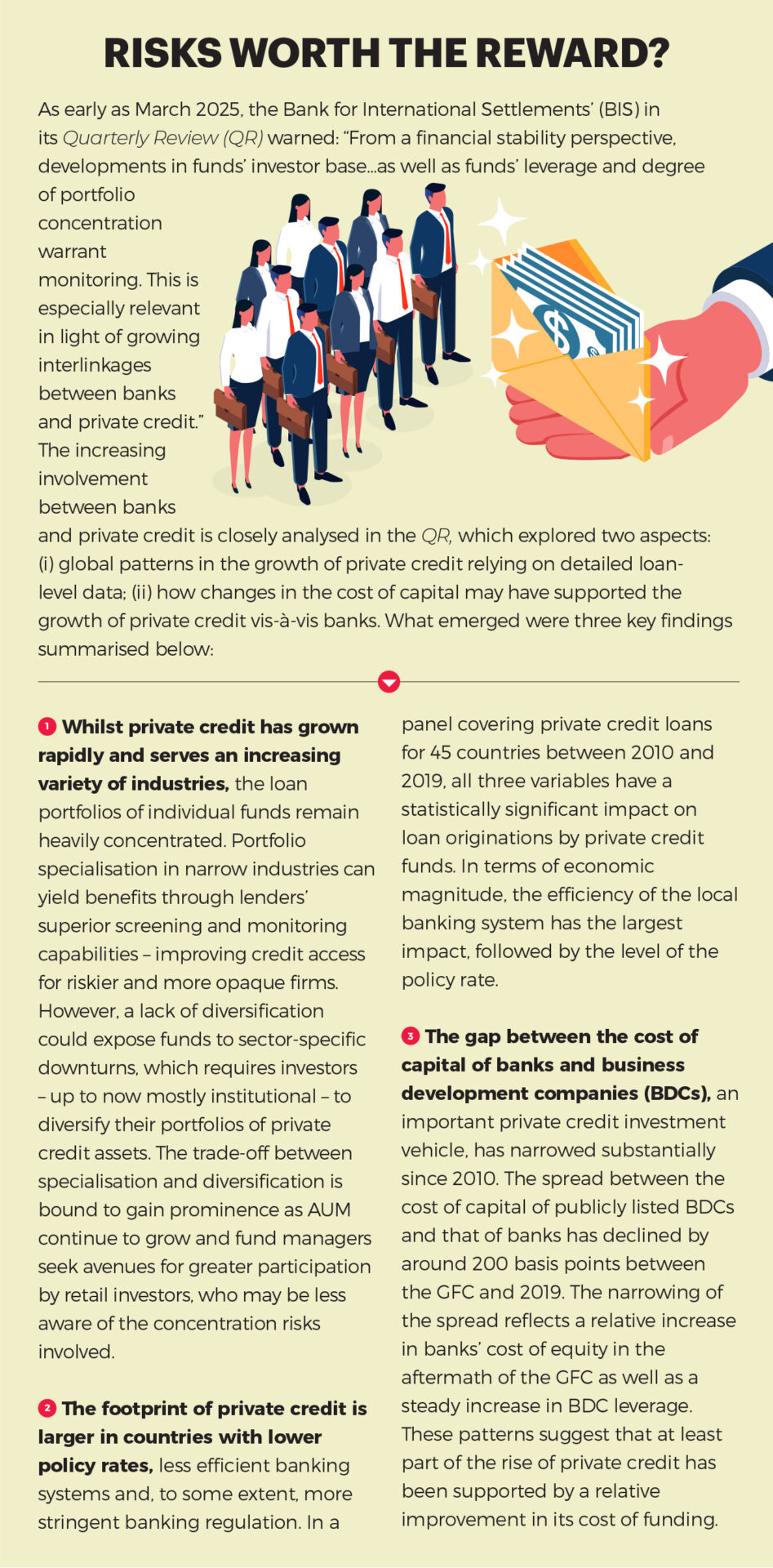
Julia Chong writes for Akasaa, a strategic consulting and publishing firm with offices in London, Sharjah, and Kuala Lumpur.